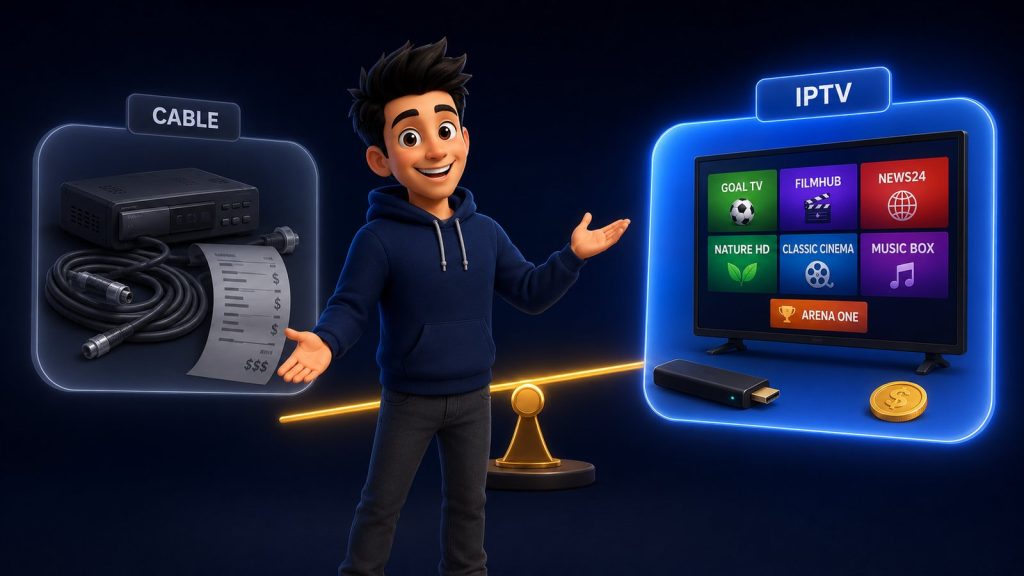
Short answer
In 2026 a realistic American cable bill is $155–$220 a month once fees and box rentals are counted. StrimoIPTV works out to $4.92–$12 a month depending on the plan you pick — for 70,000+ live channels instead of a regional bundle. For most households that is $1,700–$3,200 saved every year. Cable still wins in exactly two situations, and both are spelled out below.
This is not a sales page dressed up as a comparison. Cable does some things well, IPTV does some things badly, and the honest version is more useful to you than the cheerleading version. Here is the real math, the real trade-offs, and a straight answer on whether switching is worth it for your house.
How Does IPTV Actually Work?
IPTV stands for Internet Protocol Television. Instead of television arriving through a coaxial cable in your wall or a dish on your roof, it arrives through the internet connection you already pay for.
The chain is short: a provider receives live channel feeds and encodes them into internet-friendly streams; those streams sit on servers spread across several regions; you open a player app on a device you already own; you log in once, and the app pulls whichever stream you asked for in real time.
That is the whole architecture. No installer visit, no rented box, no drilling, no two-year contract. The picture that reaches your screen is the same picture — only the delivery pipe changed.
The practical consequence matters more than the technology. Because IPTV runs over the open internet, a provider is not limited to the channels licensed for your postcode. That is why one StrimoIPTV line can carry UK, US, Canadian, European and Arabic channels at once, while cable sells you your region and charges extra for anything outside it.
What Cable TV Really Costs in 2026
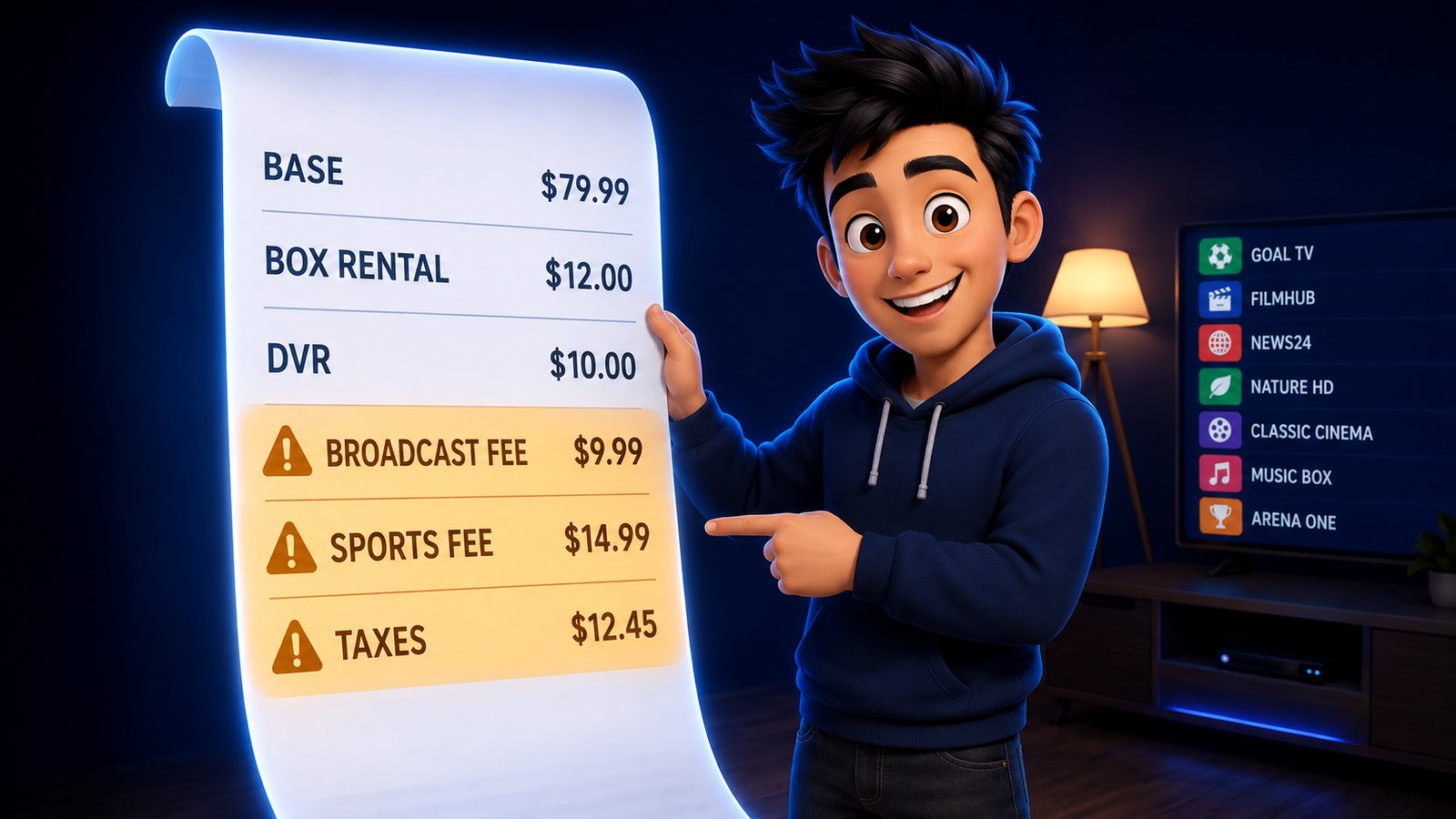
The number in the advert is never the number on the bill. That “$59.99 for 200 channels” is a 12-month promotional rate quoted before equipment, before fees and before tax. Here is what an actual bill looks like once the promo expires:
- Base package after promo: $89 – $129 per month
- Set-top box rental: $12 – $18 per box, and most homes have two or three
- DVR service: $10 – $20 per month
- Broadcast TV surcharge: around $19 per month
- Regional sports fee: $11 – $14 per month, charged whether you watch sport or not
- HD technology fee: up to $10 per month
- Taxes and surcharges: another 10–15% on the total
Add it up and a realistic all-in cable bill for a two-TV household lands between $155 and $220 per month — roughly $1,900 to $2,600 a year. That still excludes premium movie add-ons, a sports season pass or an international channel pack.
The fees are not optional and the price is designed to rise. The broadcast surcharge and the regional sports fee cannot be removed even if you never watch local news or a single game, and the jump at month 13 is not a mistake — it is the business model.
What StrimoIPTV Really Costs
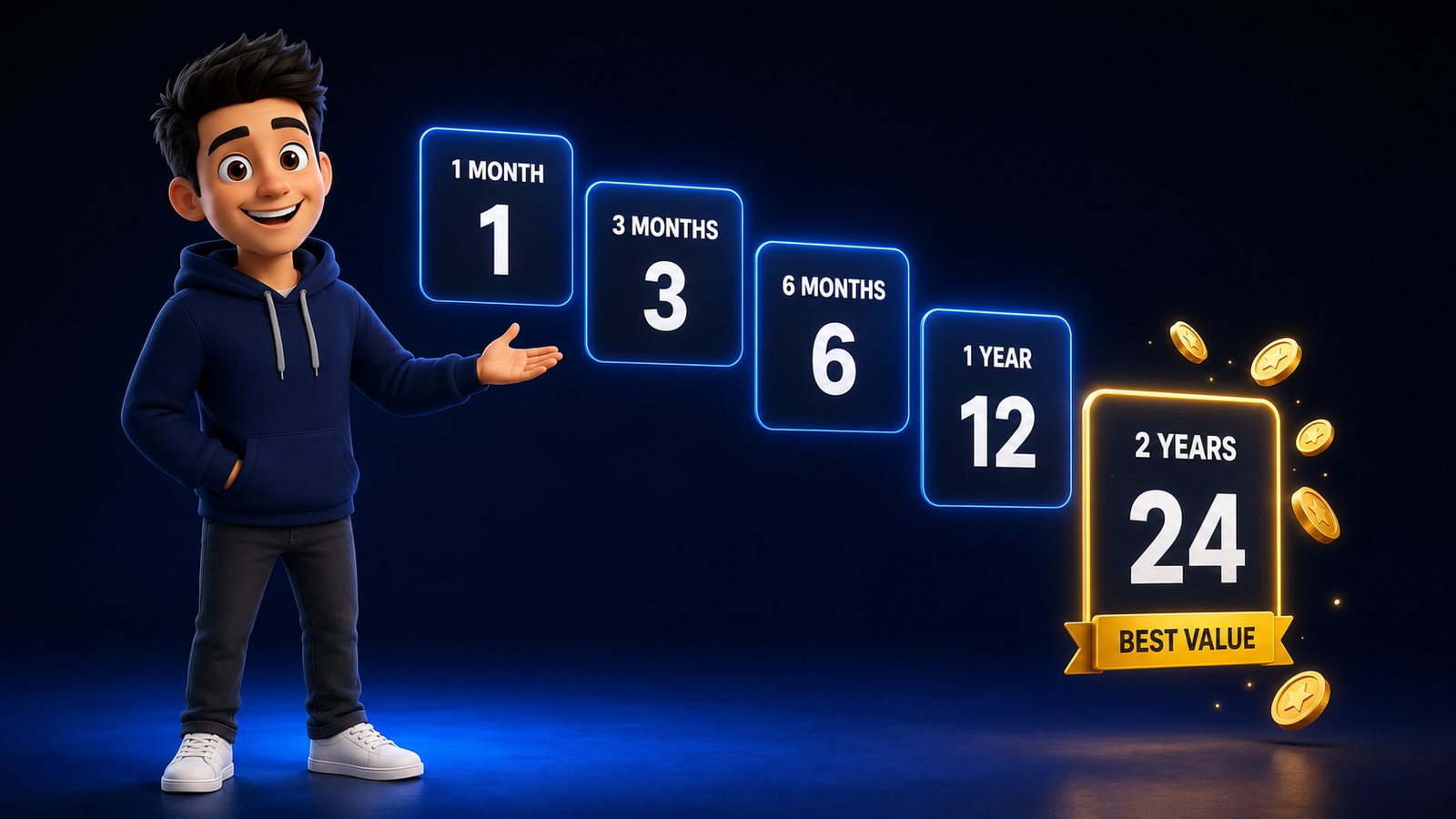
IPTV pricing works the opposite way round: one flat price, paid up front, for a fixed period, with no equipment and no add-ons. Here is exactly what StrimoIPTV charges, with the true monthly cost worked out so you can compare like with like:
| Plan | You pay | Real cost per month | Vs. a $180 cable bill |
|---|---|---|---|
| Starter — 1 month | $12 | $12.00 | Saves $168/mo |
| Plus — 3 months | $25 | $8.33 | Saves $171/mo |
| Pro — 6 months | $40 | $6.67 | Saves $173/mo |
| Ultimate — 12 months | $59 | $4.92 | Saves $175/mo |
Every plan includes the same library: 70,000+ live channels, 250,000+ movies and series, up to 8K, 4K, Full HD and HD quality, anti-freeze servers and 24/7 human support. There is no equipment rental because you use your own Firestick or Smart TV. No DVR fee, no broadcast surcharge, no regional sports fee, and nothing renews on its own.
So when people ask how much IPTV costs, the honest answer is between four and a half and twelve dollars a month, and the longer the plan the lower the number. The Ultimate plan is the cheapest per month; the Starter plan exists so you can test the service properly before committing.
IPTV vs Cable TV — Side by Side
| Feature | Cable TV | StrimoIPTV |
|---|---|---|
| Real monthly cost | $155 – $220 | $4.92 – $12 |
| Live channels | 150 – 300 (regional) | 70,000+ (worldwide) |
| Movies & series on demand | Limited, pay-per-view extra | 250,000+ titles included |
| Picture quality | Mostly 1080p, 4K costs extra | Up to 8K / 4K / FHD included |
| International channels | $15 – $30 per language pack | UK, US, CA, EU and Arabic included |
| Contract | 12 – 24 months, early exit fee | None — nothing auto-renews |
| Equipment | Rented boxes, per room | Devices you already own |
| Setup | Technician visit, 1 – 2 weeks | About 5 minutes, self-serve |
| Second screen | Extra box, extra fee | 2 simultaneous connections from Pro |
| Works during an internet outage | Usually yes | No |
| Price rises after year one | Almost always | No — you paid up front |
Channels: Who Actually Wins?
Cable advertises channel counts in the hundreds. But viewing research has been consistent for over a decade: the average household regularly watches somewhere between 15 and 20 channels. You pay for a bundle of 250 and live inside about 7% of it.
IPTV inverts the model. Instead of a fixed regional bundle chosen for you, you get a very large global library and you build your own front page out of it. A StrimoIPTV line covers:
- US networks — national sports, news, premium movie networks, documentary and lifestyle channels
- UK and Ireland — terrestrial channels, the full sports tiers, and the usual entertainment line-up
- Canada — national broadcasters plus regional feeds
- Europe — French, Spanish, German, Italian, Portuguese and Nordic channels
- Arabic and MENA — the regional entertainment, news and sports spread
- Sport and events — football, UFC, boxing, F1, cricket, NBA, plus PPV and event feeds
The full breakdown is on the channel list page. The point is not that more is automatically better — it is that a household with a grandmother who watches Arabic news, a Premier League fan and a kid who only watches cartoons pays cable three separate surcharges for that, and pays StrimoIPTV nothing extra at all.
Picture Quality: Is IPTV as Good as Cable?
For most viewers, on most channels, IPTV looks equal or better. Three reasons:
- Native 4K where the source allows it. Most cable packages are still 1080i or 1080p on the majority of channels, with 4K reserved for a handful and often billed separately.
- Modern codecs. H.265/HEVC delivers a sharper picture at lower bandwidth than the older compression sitting in a lot of cable infrastructure.
- Per-channel bitrate. A good IPTV server does not have to squeeze hundreds of channels down one shared physical pipe to your street the way a cable headend does.
The honest catch: IPTV quality is only as good as your internet. Plan for at least 15 Mbps for reliable HD and 25 Mbps for 4K, with headroom if several people stream at once. Below about 10 Mbps no provider on earth will look good — and there, cable genuinely holds an advantage, at six to fifteen times the price.
Reliability: The One Place Cable Still Wins
This is the part most IPTV articles skip, so let us be direct about it.
Cable television does not depend on the open internet. If your ISP has an outage, cable usually keeps working because it runs on its own infrastructure to your house. IPTV does not have that luxury: no internet, no television.
How much that matters depends entirely on where you live. In most urban and suburban areas, total ISP downtime adds up to a few hours a year and a phone hotspot covers you through it. In a rural area with a flaky line and weekly dropouts, that same fact is a genuine reason to keep cable — or at least to fix the internet before cancelling anything.
The other half of reliability is the provider itself, and IPTV services differ enormously here. A serious provider runs redundant anti-freeze servers so one failure does not black out your evening. StrimoIPTV holds a 99.9% uptime guarantee with an instant replacement line if a server goes down, and keeps human support on WhatsApp rather than a ticket queue — which, when a match starts in four minutes, is the difference that actually counts.
Real-World Math: A Family of Four
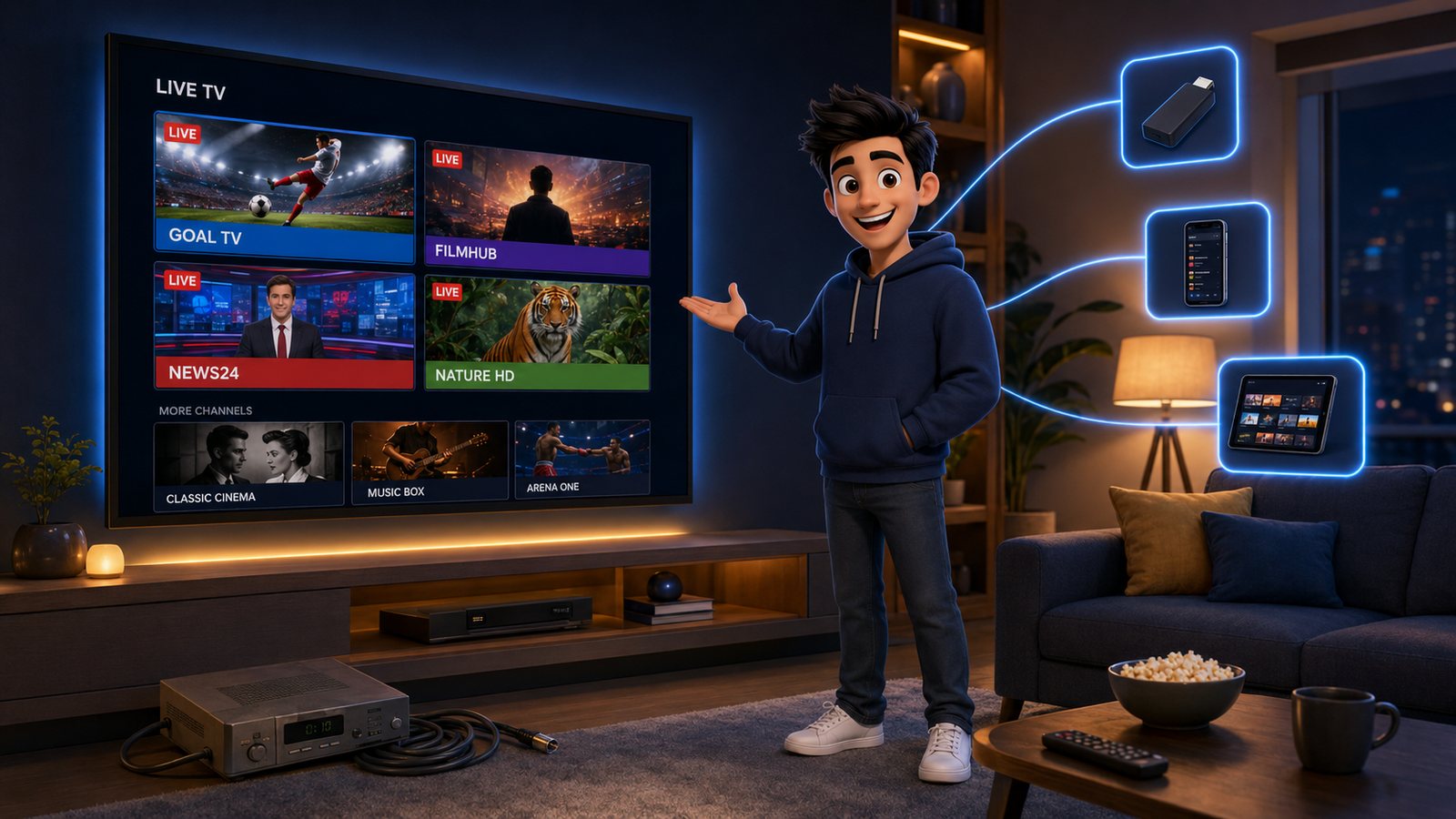
Abstract percentages are easy to ignore, so here is a concrete household: two TVs, a DVR, one premium movie add-on, a sports season pass, and one Spanish-language pack.
On cable: base package after promo $109, two box rentals $28, DVR $15, broadcast and regional sports fees $32, premium movie add-on $16, sports season pass spread across the year $30, Spanish-language pack $15, taxes and surcharges about $27. Total: roughly $272 per month, or $3,264 per year.
On StrimoIPTV: the Ultimate plan at $59 for twelve months. Equipment: $0 — the household already owns a Firestick and a Smart TV. Movie library, sports channels and Spanish-language channels: included. Total: $4.92 per month, or $59 per year.
Annual difference: roughly $3,200. Even against a much leaner $150-a-month cable bill the gap is still about $1,745 a year. There is no arrangement of these numbers where cable comes out cheaper.
Is IPTV Safe to Use?
Two different questions hide inside this one, and they deserve separate answers.
Is the technology safe? Yes. IPTV is ordinary video streaming over your ordinary internet connection — the same mechanism as any mainstream streaming app. There is nothing inherently risky about the delivery method.
Is every provider safe? No, and pretending otherwise would be dishonest. This market has plenty of operators who take payment and vanish a month later. The checks that separate a real service from a burner are simple, and you should apply them to us as readily as to anyone else:
- Is there a real human you can message before you pay — and do they answer?
- Is the price list published on the site, or do you have to negotiate it in private messages?
- Can you test the service on your own TV before committing to a long plan?
- Do they push you toward untraceable payment methods only? That is the loudest red flag in this industry.
Install player apps only from the official store on your device, keep your login details to yourself, and use a provider that answers. That covers the realistic risks.
So — Is IPTV Worth It?
Switch to IPTV if you have home internet of 25 Mbps or better; watch sport, films or channels from more than one country; own a Firestick, Smart TV, Android box, tablet or phone; are tired of a bill that grows every twelve months; or want to watch in more than one room without paying per room.
Keep cable if you have genuinely unreliable internet — frequent dropouts, or under 10 Mbps — or are locked into a bundle where cancelling TV would raise your internet price by more than the TV costs. Run those numbers honestly; it is rarer than providers imply.
That is the complete list. For everyone else, the comparison stopped being close some time ago.
How to Switch From Cable to IPTV in Three Steps
- Test before you cancel anything. Message us on WhatsApp for a trial, or start on the $12 Starter plan. Watch on your own TV, on your own internet, at your usual evening peak — that is the only test that means anything.
- Set up your device. Install IPTV Smarters Pro or TiviMate on your Firestick or Smart TV and log in with the details we send. The installation guide covers every device, and support will screen-share it with you if you would rather not do it alone.
- Then cancel cable. Only once you have streamed happily for a few days. Ask for internet-only pricing while you are on the call — you keep the connection, you drop the television.
Frequently Asked Questions
Is IPTV cheaper than cable TV?
Yes, substantially. A realistic cable bill is $155–$220 a month, while StrimoIPTV works out to $4.92–$12 a month depending on plan length. For a typical household that is $1,700–$3,200 saved per year.
How much is IPTV per month?
StrimoIPTV costs $12 for one month, $25 for three months, $40 for six months and $59 for a full year — an effective monthly cost between $4.92 and $12, with no equipment fees and nothing renewing automatically.
Do I need to cancel my internet to switch to IPTV?
No — the opposite. IPTV needs your internet connection. You cancel the television portion of your cable package and ask the provider for internet-only pricing, which is usually $40–$70 a month.
How much internet speed do I need for IPTV?
15 Mbps for stable HD, 25 Mbps for 4K, and around 50 Mbps if several people stream at the same time. A wired Ethernet connection is more consistent than Wi-Fi for the main TV.
Is IPTV as reliable as cable?
Nearly, with one exception: IPTV stops working during an internet outage and cable usually does not. StrimoIPTV offsets this with anti-freeze redundant servers, a 99.9% uptime guarantee and an instant replacement line, but your ISP remains the single point of failure.
Can I watch IPTV on more than one TV?
Yes. The apps install on as many devices as you like, and the Pro and Ultimate plans include two simultaneous connections so two people can watch different channels at the same time.
Is IPTV safe to use?
The technology itself is standard internet streaming and carries no special risk. The variable is the provider: choose one with published prices, reachable human support, a testable trial and clear contact details, and install player apps only from your device’s official store.
What happens when my StrimoIPTV plan ends?
Nothing automatic. There is no contract and no rolling charge — the plan simply expires and you decide whether to renew. That is the structural difference from cable, where cancelling is the hard part by design.
Cable bill still arriving every month?
70,000+ live channels and 250,000+ movies and series from $4.92 a month. Order in two minutes and we email you the payment link and your login.